



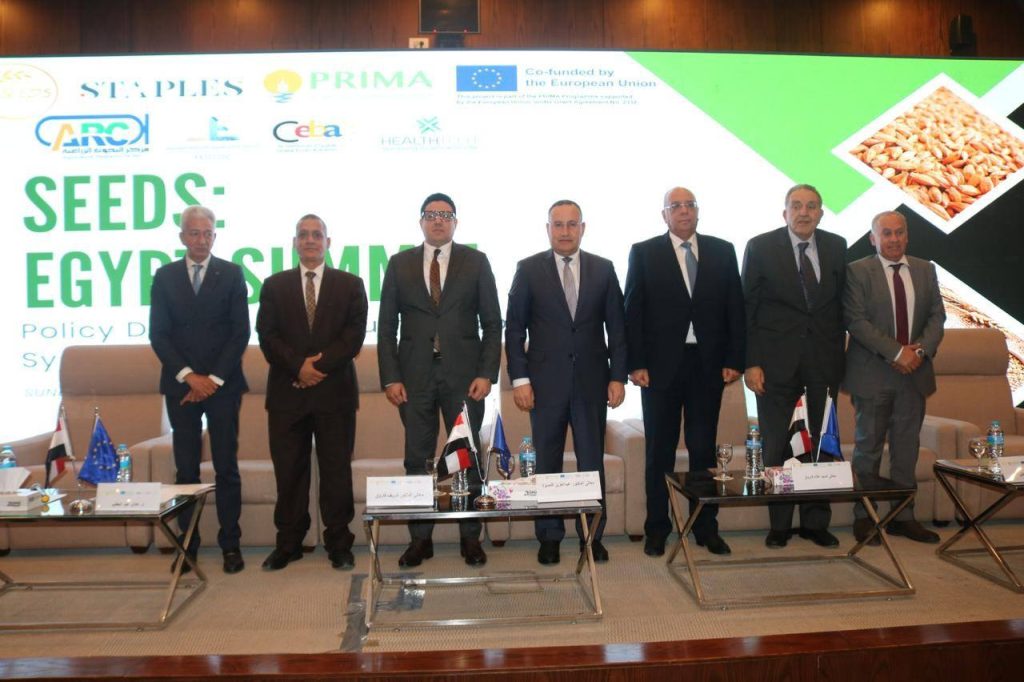
On behalf of Mr. Alaa Farouk, Minister of Agriculture and Land Reclamation, and in the presence of Dr. Abdel Aziz Qonsouh, Minister of Higher Education and Scientific Research, and Mr. Ahmed El-Wakil, President of Federation of Egyptian Chambers of Commerce (FEDCOC), Dr. Hosam Shawky, President of Desert Research Center, participated in the launch of “SEEDS PRIMA Egypt Summit”, entitled “Dialogue on Sustainable Food Policies,” at the headquarters of the Federation of Egyptian Chambers of Commerce.
Dr. Mogahed Ammar, Director of the Field Crops Research Institute (FCRI) at the Ministry of Agriculture and Land Reclamation, and Dr. Ahmed Abo Al-Gheit, Assistant Minister of Supply and Internal Trade, also participated in the event, in addition to representatives from numerous research institutions, international organizations, and the private sector.
In his address, President of Desert Research Center explained that the summit’s themes align with Egypt’s Vision 2030, which prioritizes achieving food security, the sustainable use of natural resources, and adaptation to climate change. He noted that the state is working to build a modern agricultural sector based on maximizing added value, improving production efficiency, reducing losses, supporting innovation, and strengthening public-private partnerships.
Shawky pointed out that Egypt has achieved significant production leaps in several strategic crops. Wheat production has exceeded 10 million tons annually, maize production has reached approximately 7.5 million tons, and rice production has achieved self-sufficiency with nearly 5 million tons. This is thanks to horizontal and vertical expansion, the development of irrigation systems, and the use of high-yield seeds that are resistant to climate change.
President of DRC highlighted the Ministry of Agriculture’s commitment to strengthening cooperation with research centers, universities, and international partners to translate research findings into practical applications that support farmers and policymakers, and contribute to achieve sustainable agricultural development. He noted that the “SEEDs” project represents a successful model for integrating scientific research and policy dialogue by providing a platform to enhance coordination among various stakeholders.
